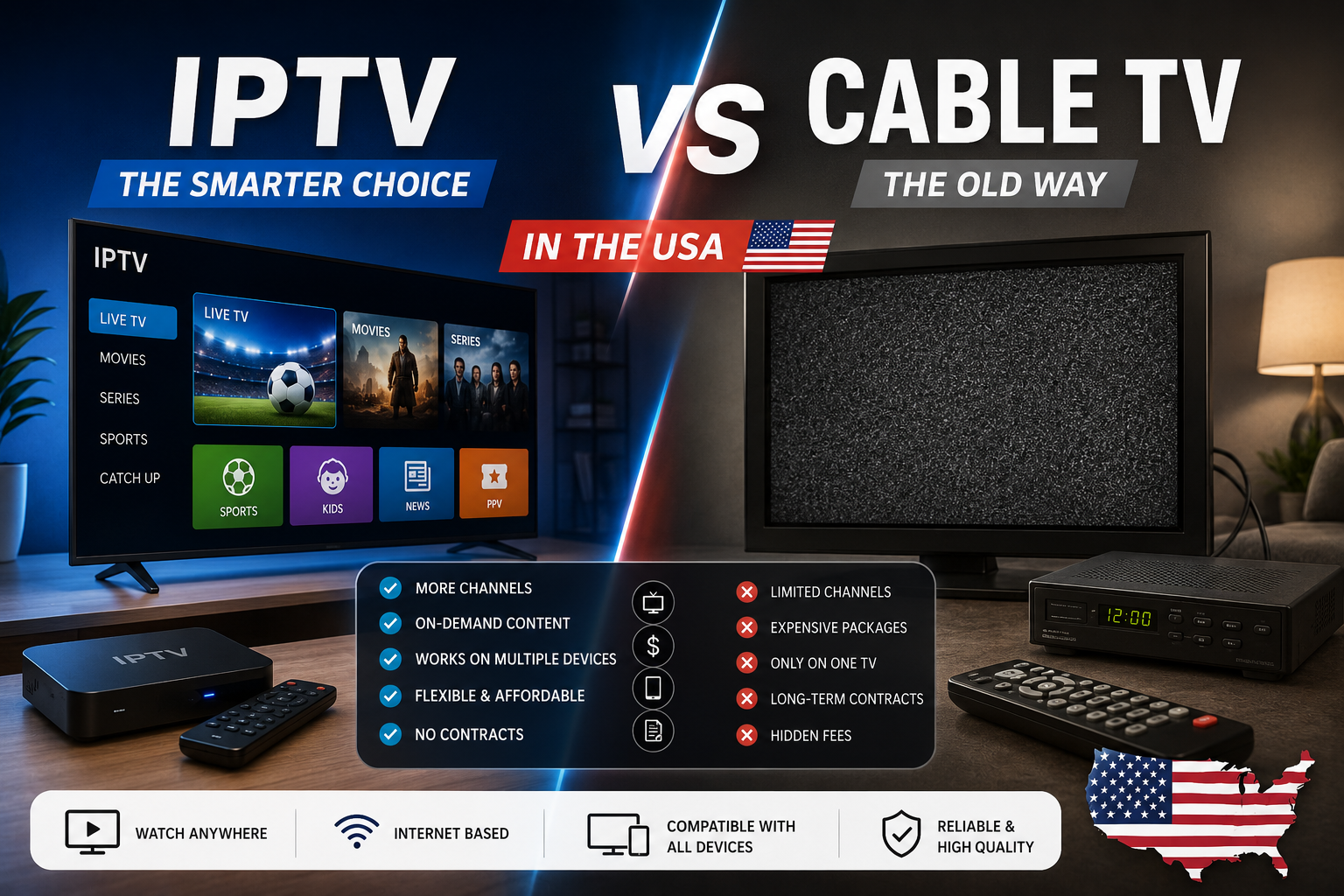
IPTV vs Cable TV in the USA: Which Is Better in 2026?
For decades, cable television dominated American households, offering hundreds of channels through traditional coaxial connections. Today, however, more people are cutting the cord in favor of Internet Protocol Television (IPTV), a modern way to stream live TV, movies, sports, and on-demand content over the internet.
But which option is actually better for viewers in the United States?
In this guide, we’ll compare IPTV vs Cable TV in the USA, examining costs, channel selection, picture quality, flexibility, device compatibility, and overall value. Whether you’re considering switching from cable or exploring IPTV for the first time, this comparison will help you make an informed decision.
Looking for a complete overview of IPTV? Be sure to read our comprehensive IPTV USA guide to learn everything about IPTV services, supported devices, and streaming options.
What Is IPTV?
IPTV (Internet Protocol Television) delivers television content through an internet connection instead of traditional cable or satellite infrastructure. Rather than relying on coaxial cables installed throughout a neighborhood, IPTV streams live channels and video-on-demand content directly to compatible devices.
Unlike traditional broadcasting, IPTV allows viewers to choose where and when they watch their favorite content. Many IPTV services also include useful features such as:
- Live TV channels
- Video on Demand (VOD)
- TV series libraries
- Electronic Program Guide (EPG)
- Multi-device compatibility
- High-definition and 4K streaming
- Catch-up TV (where available)
Because IPTV only requires a stable internet connection, users can enjoy television on smart TVs, streaming devices, smartphones, tablets, and computers.
What Is Cable TV?
Cable TV uses a network of coaxial cables to deliver television signals directly into homes. Major providers in the United States bundle television with internet and phone services, offering predefined channel packages.
Cable television has long been recognized for its reliability, particularly in areas where internet infrastructure may not support high-quality streaming.
However, traditional cable subscriptions often include:
- Long-term contracts
- Equipment rental fees
- Installation appointments
- Limited customization
- Higher monthly costs
While cable remains popular among some households, increasing numbers of Americans are choosing internet-based alternatives due to greater flexibility and better overall value.
IPTV vs Cable TV: The Biggest Differences
Although both services provide access to live television, they operate very differently.
Cable TV depends on physical infrastructure and dedicated television networks. IPTV, on the other hand, uses broadband internet to stream content on demand.
This difference impacts nearly every aspect of the viewing experience, including pricing, convenience, available features, and device compatibility.
Let’s examine these differences more closely.
Installation and Setup
One of the biggest advantages of IPTV is how quickly it can be set up.
IPTV Setup
Most IPTV services can be activated within minutes. After receiving login credentials, users simply install a compatible IPTV application on their preferred device and enter their account details.
Common IPTV devices include:
- Amazon Fire TV Stick
- Android TV boxes
- Google TV
- Apple TV
- Samsung Smart TVs
- LG Smart TVs
- Windows PCs
- Mac computers
- Android phones
- iPhones
- Tablets
No technician visits or complicated wiring are required. follow our How to Install IPTV on Android TV USA (2026 Guide) for step-by-step instructions on installing an IPTV app, adding your subscription details, and optimizing your streaming experience.
Cable TV Installation
Cable TV typically requires:
- Scheduling an installation appointment
- Equipment setup
- Cable box installation
- Coaxial wiring
- Activation by the provider
While some providers offer self-installation kits, many customers still require professional installation before service becomes available.
Winner: IPTV
Monthly Costs
Price is one of the main reasons many Americans switch from cable to IPTV.
Traditional cable subscriptions often include:
- Base television package
- Equipment rental
- Broadcast fees
- Regional sports fees
- Taxes
- Additional premium channel charges
The monthly cost can increase significantly after promotional pricing expires.
IPTV subscriptions, by comparison, are generally straightforward. Most providers offer monthly, quarterly, or annual plans without requiring equipment rentals or installation fees.
For households looking to reduce entertainment expenses while maintaining access to live TV and on-demand content, IPTV often provides a more budget-friendly solution.
Winner: IPTV
Channel Selection
Cable providers generally divide channels into packages. Customers may need to upgrade to higher-priced plans to receive premium sports, entertainment, or international programming.
IPTV services often offer significantly broader channel selections that may include:
- Local programming
- National news
- Sports networks
- International channels
- Movies
- Kids programming
- Documentary channels
- Lifestyle content
- Music channels
Many IPTV services also include thousands of movies and television series within the same subscription.
This broad selection appeals to viewers who want access to content from multiple countries without purchasing separate channel packages.
Winner: IPTV
Picture Quality
Streaming quality depends on different factors for each technology.
IPTV Quality
With a reliable high-speed internet connection, IPTV can deliver:
- HD
- Full HD
- 4K Ultra HD
Modern compression technologies allow IPTV providers to stream high-quality content while maintaining efficient bandwidth usage.
Cable Quality
Cable television generally provides stable HD quality. While some providers offer 4K content, availability is often limited to select events or premium programming.
Overall, both services can produce excellent picture quality, but IPTV has become increasingly competitive thanks to faster broadband internet across the United States.
Winner: Tie
Flexibility and Convenience
This is where IPTV clearly stands out.
Cable TV is largely designed around watching television from a single location using provider-issued equipment.
IPTV allows users to enjoy content from virtually anywhere with an internet connection.
For example, viewers can watch:
- Sports while traveling
- News from a hotel room
- Movies on a tablet
- TV shows on a smartphone
- Live television on multiple compatible devices
This flexibility fits modern lifestyles where viewers expect entertainment to follow them rather than remain tied to a single television.
Device Compatibility
Today’s households use far more than traditional televisions.
IPTV works across numerous platforms, making it easy to switch between devices throughout the day.
Compatible devices commonly include:
- Fire TV Stick
- Android TV
- Apple TV
- Chromecast
- Samsung TVs
- LG TVs
- Smartphones
- Tablets
- Windows PCs
- macOS computers
Cable television usually requires a cable box or provider-supported application, depending on the service.
For families using multiple devices, IPTV offers greater convenience.
check out our IPTV on Samsung Smart TV for step-by-step instructions on installing an IPTV player, configuring your subscription, and optimizing your streaming experience.
Video on Demand (VOD)
Another major advantage of IPTV is built-in Video on Demand.
Instead of waiting for scheduled programming, users can browse extensive libraries of:
- Movies
- TV series
- Box sets
- Documentaries
- Children’s programming
Cable providers often offer on-demand libraries as well, but these may require additional subscriptions or premium packages.
For viewers who enjoy binge-watching series or choosing content on their own schedule, IPTV delivers a more modern viewing experience.
Sports Coverage
Sports fans are among the biggest beneficiaries of IPTV.
Many IPTV services provide access to a wide variety of sports programming, including:
- Football
- Basketball
- Baseball
- Hockey
- Soccer
- UFC
- Boxing
- Tennis
- Golf
- Motorsports
Rather than purchasing multiple sports packages, viewers can often access a broad selection within a single subscription, depending on the service they choose.
IPTV vs Cable TV Comparison Table
| Feature | IPTV | Cable TV |
|---|---|---|
| Delivery Method | Internet connection | Coaxial cable network |
| Installation | Instant online setup | Technician or self-installation |
| Monthly Cost | Typically lower | Often higher with additional fees |
| Contracts | Usually flexible | Frequently requires contracts |
| Equipment | Smart TV or streaming device | Cable box required in many cases |
| Live TV | ✔ Yes | ✔ Yes |
| Video on Demand | ✔ Extensive libraries | ✔ Available on many plans |
| Device Compatibility | Smart TVs, Firestick, Android, Apple TV, PC, Mac, mobile devices | Mostly TV and provider-supported apps |
| Picture Quality | HD, Full HD, 4K | HD and limited 4K content |
| Portability | Watch anywhere with internet | Usually limited to home service |
| International Channels | Often extensive | Usually premium add-ons |
Reliability: Which Is More Dependable?
IPTV vs Cable TV in the USA
Reliability depends on the infrastructure behind each service.
Cable TV has long been known for consistent performance because it uses dedicated physical lines. As long as there are no outages or equipment issues, viewers generally experience uninterrupted television.
IPTV relies on your internet connection. If your internet is fast and stable, streaming can be exceptionally smooth with excellent picture quality. However, a slow or congested network may lead to buffering or reduced video quality.
For the best IPTV experience, consider:
- Internet speeds of at least 25 Mbps for HD streaming.
- 50 Mbps or more for multiple devices or 4K content.
- Using an Ethernet connection whenever possible instead of Wi-Fi.
- Keeping your streaming device updated.
The Federal Communications Commission (FCC) provides guidance on broadband speeds and internet performance, making it a useful resource for understanding home internet requirements: FCC Broadband Speed Guide
Pros and Cons of IPTV
Pros
- Lower monthly costs compared to many cable plans
- No technician visits for setup
- Works on multiple devices
- Large selection of live channels
- Extensive Video on Demand libraries
- Supports HD, Full HD, and 4K streaming
- Easy to watch while traveling
- Flexible subscription options
Cons
- Requires a reliable internet connection
- Performance depends on network quality
- Streaming quality may decrease on congested Wi-Fi networks
Pros and Cons of Cable TV Vs IPTV in the USA
Pros
- Stable television signal
- Familiar user experience
- Less dependent on home Wi-Fi
- Well-established customer support from major providers
Cons
- Higher monthly costs
- Equipment rental fees
- Long-term contracts with some providers
- Limited flexibility
- Fewer supported viewing devices
- Installation appointments may be required
Which Option Is Better for Different Types of Viewers?
Choose IPTV if you:
- Want to reduce monthly entertainment costs.
- Watch TV on multiple devices.
- Travel frequently.
- Enjoy international programming.
- Prefer on-demand movies and TV series.
- Want access to live sports alongside entertainment.
- Like flexible subscription plans without long-term commitments.
Choose Cable TV if you:
- Prefer a traditional television setup.
- Have limited internet availability.
- Want a familiar experience with local provider support.
- Don’t plan to stream on multiple devices.
Is IPTV Replacing Cable TV in the USA?
Over the past several years, many Americans have shifted away from traditional cable in favor of internet-based entertainment. Faster broadband connections, smart TVs, and streaming devices have made IPTV and other streaming solutions more accessible than ever.
While cable television still serves millions of households, consumer preferences continue to evolve toward greater flexibility and on-demand viewing. Rather than being tied to scheduled programming or a single television, viewers increasingly expect to watch content whenever and wherever they choose.
This shift reflects changing viewing habits, with convenience, device compatibility, and content variety becoming key factors in choosing a television service.
Frequently Asked Questions
Is IPTV cheaper than cable TV?
In many cases, yes. IPTV subscriptions are often more affordable because they typically avoid equipment rental fees, installation charges, and long-term contracts commonly associated with traditional cable services.
Does IPTV require fast internet?
A stable broadband connection is recommended. Around 25 Mbps is generally sufficient for HD streaming, while faster speeds are beneficial for 4K content or multiple simultaneous streams.
Can I watch IPTV on multiple devices?
Many IPTV services support multiple compatible devices, including smart TVs, streaming devices, smartphones, tablets, and computers. The number of simultaneous streams depends on the subscription you choose.
Which has better picture quality?
Both IPTV and cable can deliver excellent HD content. With a strong internet connection, IPTV can also provide impressive Full HD and 4K streaming quality.
Is cable TV becoming outdated?
Cable TV remains a popular option for many households, but internet-based television has grown significantly as viewers seek more flexibility, on-demand content, and multi-device compatibility.
Final Verdict: IPTV vs Cable TV in the USA
When comparing IPTV vs Cable TV in the USA, the best choice depends on your viewing habits and priorities.
If you value flexibility, affordability, extensive content libraries, and the ability to watch across multiple devices, IPTV offers a compelling modern alternative to traditional television. With simple setup, support for HD and 4K streaming, and access to both live channels and on-demand entertainment, it meets the expectations of today’s connected households.
Cable TV, however, continues to be a dependable option for viewers who prefer a conventional television experience and have access to reliable cable infrastructure.
As internet speeds continue to improve across the United States, more households are exploring internet-based television solutions that better align with modern lifestyles.
If you’re new to IPTV, don’t miss our complete IPTV USA guide, where you’ll learn how IPTV works, compatible devices, key features to look for, and tips for getting the best streaming experience.
IPTV USA Free Trial: Test Before You Buy (2026) - tuneinvision.us
July 15, 2026[…] you’re ready to explore premium streaming options, check out our guide to the Cable Vs IPTV In The USA to compare features and find a service that matches your viewing […]